About Waina
Biography
Waina Cheng was born in Lanzhou, 1946, China and brought up in Singapore. She began formal training at the age of eight with Chinese master painter Dr Chen Wen Hsi (陳文希) and studied Chinese Calligraphy and Western painting with him for eleven years. At the age of nineteen she left for England to study Graphic Design at the Oxford Brookes University. Later she became very good friends with the renowned British artist Dr Eric Ennion. They sketched wildlife together on many occasion. He also encouraged her to develop the use of Calligraphic techniques on subjects that she sees and feels, rather than following the traditional way of teaching Chinese Calligraphic painting, which focusses on copying landscapes, flowers and figures etc. The influence of Dr Eric Ennion transformed her way of painting wildlife. From then on, she painted only what she sketched and knew intimately. For example, "Before the rain" (the naked leaf tribe woman, on very remote border of Niger and Nigeria, walking briskly back with a heavy pot of water on her head, what a hard life!), "Silence" (broken skulls in shallow water with sea snakes and coral fish weaving in and out. These were skulls on an island, off Munda, Solomon Islands, where cannibals scattered the remains of the inhabitants of the village they raided. Waina was told the story of the raid. She canoed to the, then uninhabited, island on her own, with the intention of exploring. On arrival, seeing the scene, she felt that it had a certain silent peace. Out of respect, she could not get out of the canoe, and wanted to feel that they were, at last, all at peace).
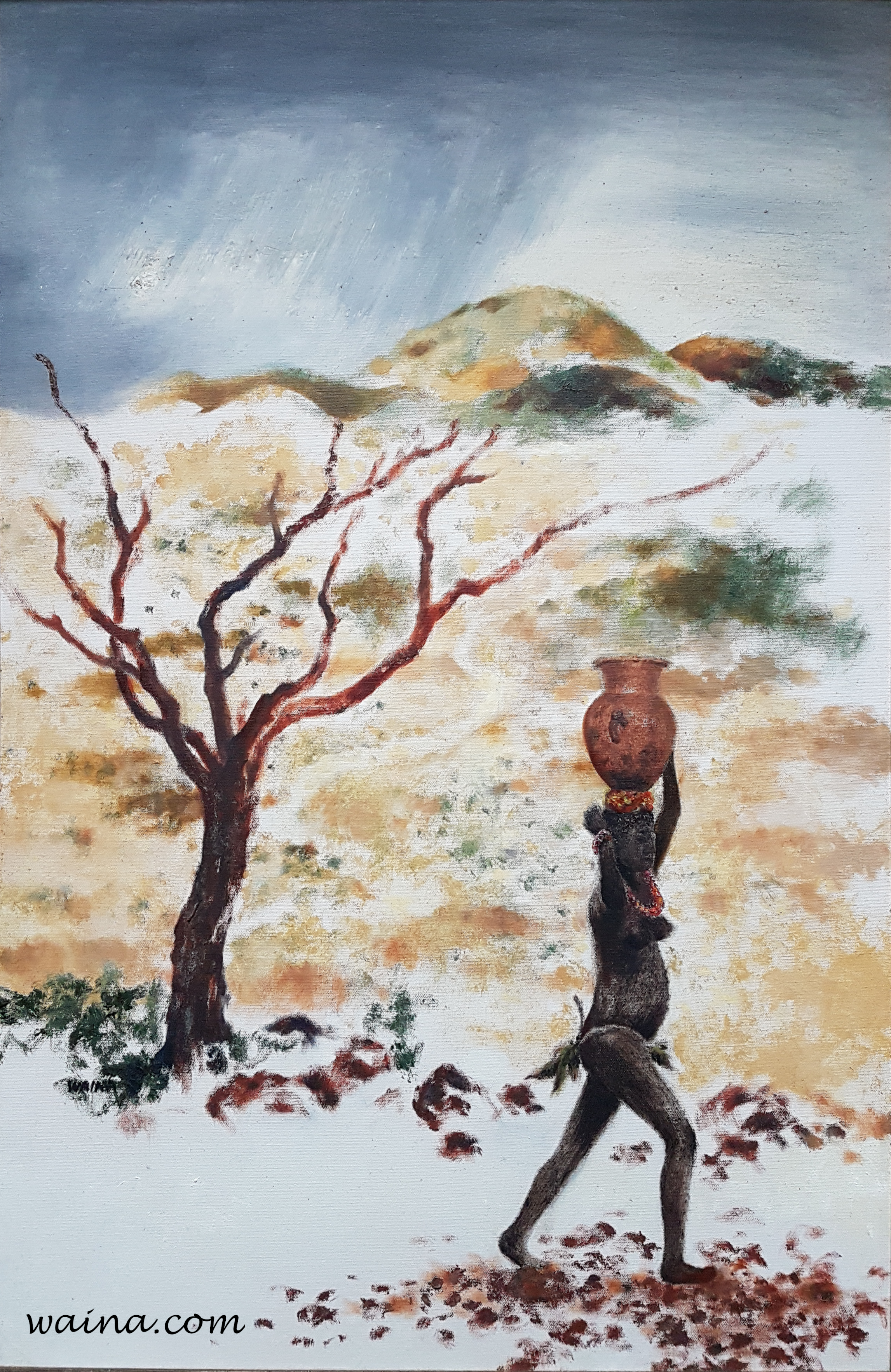
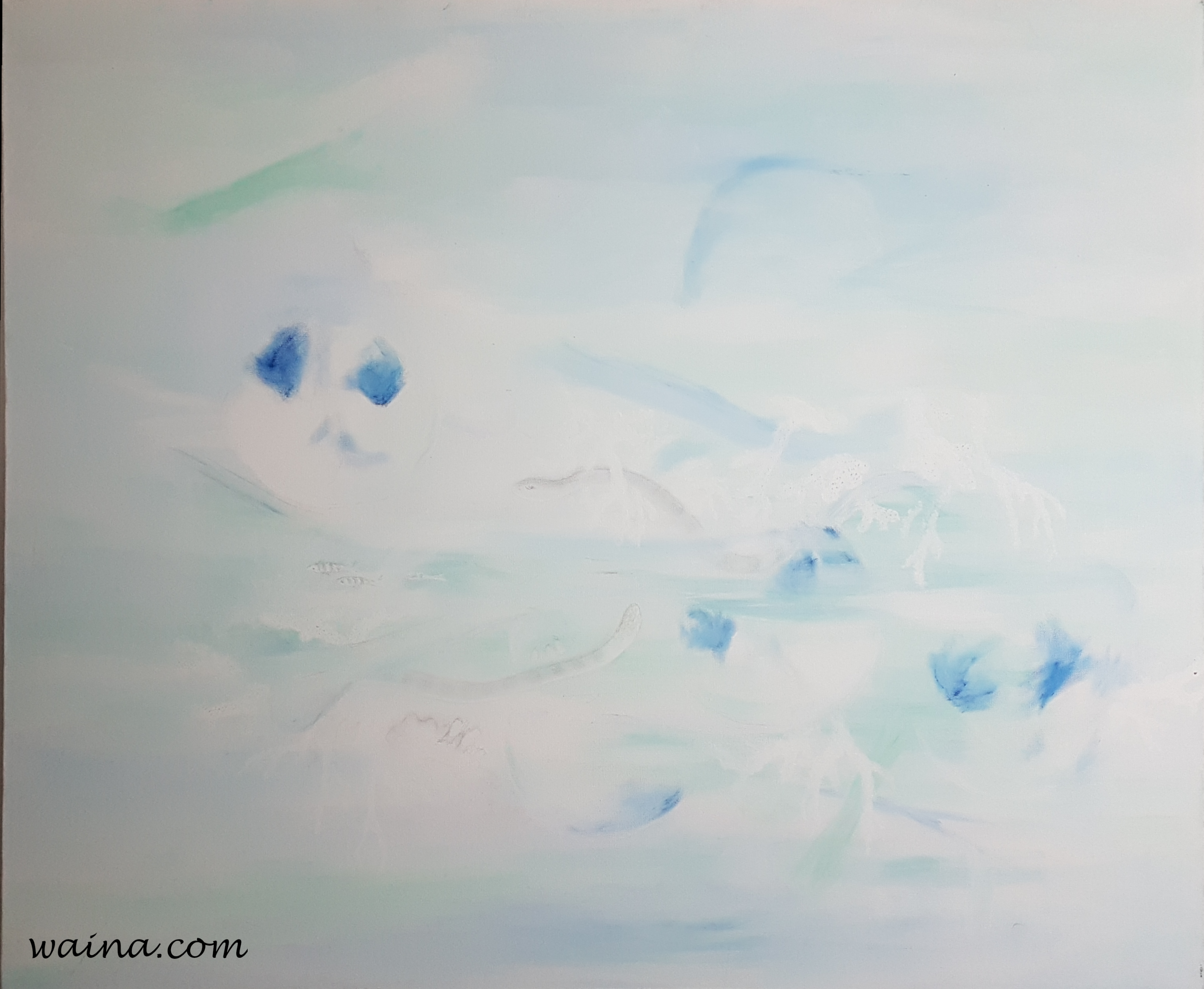
From 1968 Waina spent nine years in Africa with her husband Dr Peter Ward, a renowned ornithologist. Together they travelled through very remote, and often uninhabited, parts of Nigeria, Niger, Kenya, Tanzania, Uganda and many other countries, camping in the bush and observing the wildlife. This experience of years of sketching the animals in their native habitats is reflected in the intimate feeling and detail throughout Waina’s work.
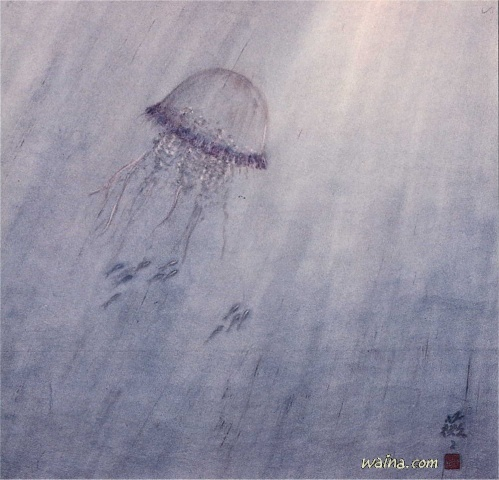
Subsequently Waina travelled extensively in Spain, USA, South East Asia, Mexico, Costa Rica, Israel and the Solomon Islands. Having painted the creatures of land and air she then took up scuba diving. This gave her a new range of subjects and perspective which is beautifully captured in paintings such as “Passing Shadow" (Shadow of fish and waves in the strong sunlight), “Squid” and “Transparent Drifter“ (Jellyfish). Waina now lives in Oxford, England and continues to pursue her art in its many forms. In 2000 she was elected a fellow of the Linnean Society.
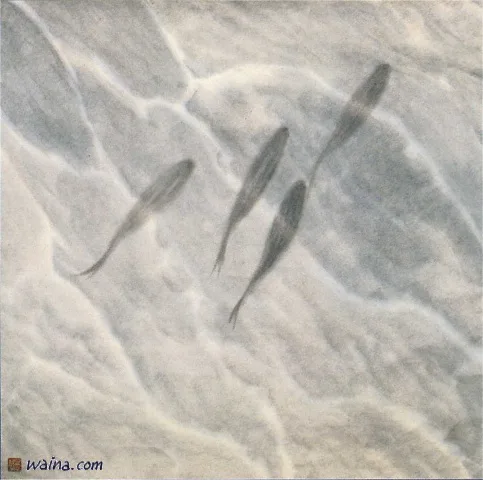
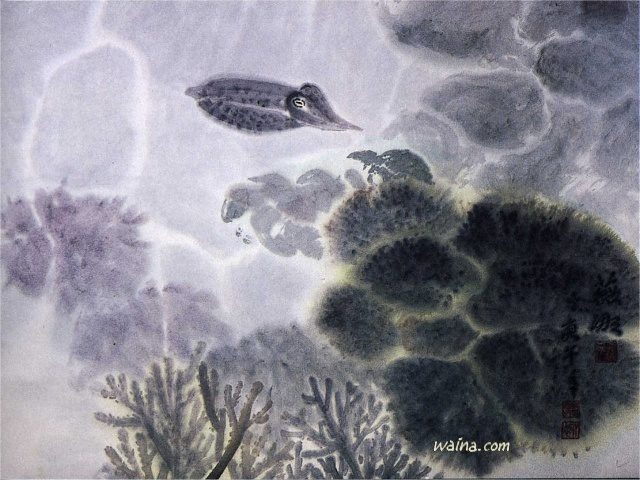
Waina would like to express her gratitude for the love and upbringing from her loving father, Cheng An Lun (鄭安侖), and mother Hwang Fu (黃馥). Her father, who was always interested in art and literature since his time at Tsing Hua University (清华大学). During that time, he became close friends with artists such as Wu Zuoren (吴作人) and Dr Chen Wen Hsi (陳文希).
Because of his passion Waina's father was always very supportive and encouraging in her love of painting ever since the early age of six.
Her Art
Her passion for painting anything that captured her attention started when she was a little girl – while her sisters were playing indoors she was out looking for creepy crawlies and drawing them. Through serious study in Chinese and Western techniques, she developed her own perspectives on the natural world and created her unique style of art. Her Chinese-style paintings are very impressionistic but very accurate at the same time: she selects details of the moods and personalities of the wonderful creatures who share her world and uses white space, she believes the white space left in a painting is as important as what is painted on, and selective composition to focus on the characteristics she wants to express.
She is very particular about keeping the realism of her subjects, including foliage and other detail from their actual habitats (for example her series of birds portrayed in watercolour, or the suggestions of scenery in her impressionistic Calligraphic art). She firmly believes that a good painting is built and painted with a firm foundation of knowledge, that is, both in technique and study and knowledge of the subjects.
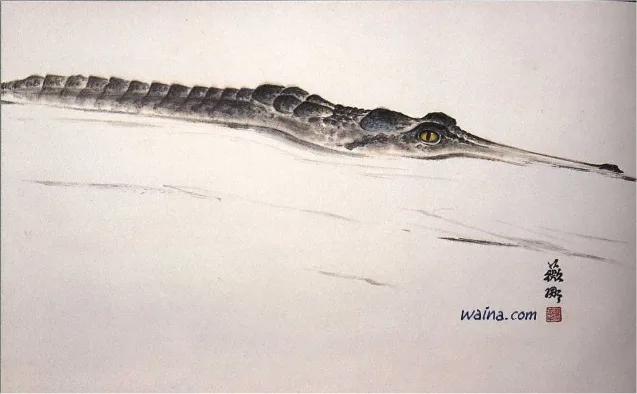
She has kept a variety of unusual pets in her time (including chameleons, scorpions and snakes) and often sees beauty in subjects that others find less appealing – for example "Peace" (Crocodile).
Waina is a versatile artist, using many different styles and media and indulging in pottery, jewellery making and clothing design to name a few! The theme running through her work whatever the media used is one of unusual wonder at the natural world, combined with a quirky sense of humour which influences her choice of subjects. Her work reminds us of the beauty of all the creatures of the natural world – even the ones often thought of as dangerous or ugly.
Waina’s pictures are all unique, she doesn’t paint copies, she doesn’t paint from photographs – only from real life and her own sketches – and she only accepts commissions when she is given artistic freedom.
Waina is also passionate about photography, especially very small insects and animals, like spiders and beetles, anything unusual she found in the tropical forest and under the sea. She also enjoyed photographing general landscapes and people. Her photograph of a Pelican in Yucatan, Mexico flying over a shoal of fish jumping out of the water was used in a double page spread by National Geographic magazine, early 1990s. A photograph of the Semana Santa procession, 1990s, in Seville was used as the cover of the Sunday Times magazine, UK.
Exhibitions
Waina has been showing her work internationally since the age of eighteen.
She has held one-person exhibitions at the Ashmolean Museum of Art & Archaeology in Oxford, The National Museum of Singapore, Arusha Hotel in Arusha, Tanzania, Watatu Galleries in Kenya, Tarbox Gallery in California USA, Europaischen Patentamts in Germany and in at various other locations in Israel, Oxford and Cambridge.
Her works have also appeared in the Mall Galleries in London, The Jagd-und-Fischerei Museum in Munich, The National Museum Art Gallery in Singapore, the National Museum Art Gallery in Malaya and in The Gallery at the Birmingham Botanical Gardens (September 9th to October 7th, 1994).
She has done illustrations for two national park guide books in Tanzania, 1969, also illustrations in the early 1970s for "The Countryman" magazine and sketches for the "Longman" publishing company.
Collections of her paintings are displayed in Ashmolean Museum of Art & Archaeology in Oxford, The British Council Art Collection in Singapore, four wall murals in Northern Nigeria, The McNiece Art Collection, Clare Hall in Cambridge and many other private collections all over the world.
Reviews
“…Rather than allow the traditional art form to restrict her expression of the subject, she challenges the form instead. Calligraphic brushstrokes, vital to Chinese painting are evident.. at the same time, details accurately identifying the various species have not been spared.. one appreciates her skill at representing that most difficult of surfaces, the texture and colour of plumage” (The Straits Times)
“One senses her love of the subject in the delicacy of line and texture” (The Straits Times)
“exquisite paintings of birds and flowers, especially birds with flowers!” (Sir Julian Huxley)
”.. could grace the pages of any reference book on ornithology” (Susan Tsang, Business Times)
Quotes
Africa
“As a child I had always wanted to travel to wild places and finally, it just happened.”
“No one was bitten by a snake, but we came across bandits and were held at gunpoint several times”
Painting
“I aim to capture the moods and personalities of these wonderful creatures who share our world”
“Space is an integral part of the composition, almost as important as the subject itself. Only the minimum should be painted to express the maximum.”
Waina often uses Chinese Calligraphic brush technique, painting with oils or acrylics, on canvas and laminate surfaces.
The Environment
“I hope the exhibition will make people more aware of the need to preserve the animals and plants that we have, before it is too late”

Her Photography
She was interested in taking photographs of wildlife, people, situations and architecture.
One of her photographs of Pelicans flying low over the sea in Yucatan, Mexico, with a shoal of fish jumping out of the water underneath, was used in magazine and the most prominent was a double page spread in the National Geographic in the early 1990s.
Another photograph of the procession of Semana Santa in Seville was used on the cover of the Sunday Times magazine in the UK in the early 1990s.
Many of her photographs are also used in wildlife and country magazines, worldwide.
Her Clothing
She designed many pieces of garments, both using cloth, knitted and crocheted garments, also with painted designs on clothing.
Her Pottery
She has created a number of pieces of pottery.
Her furniture
She has a passion in carpentry and created some wooden pieces.
See also About waina.art