An article written for the second largest Israeli newspaper, Ma'ariv.
First page of the article
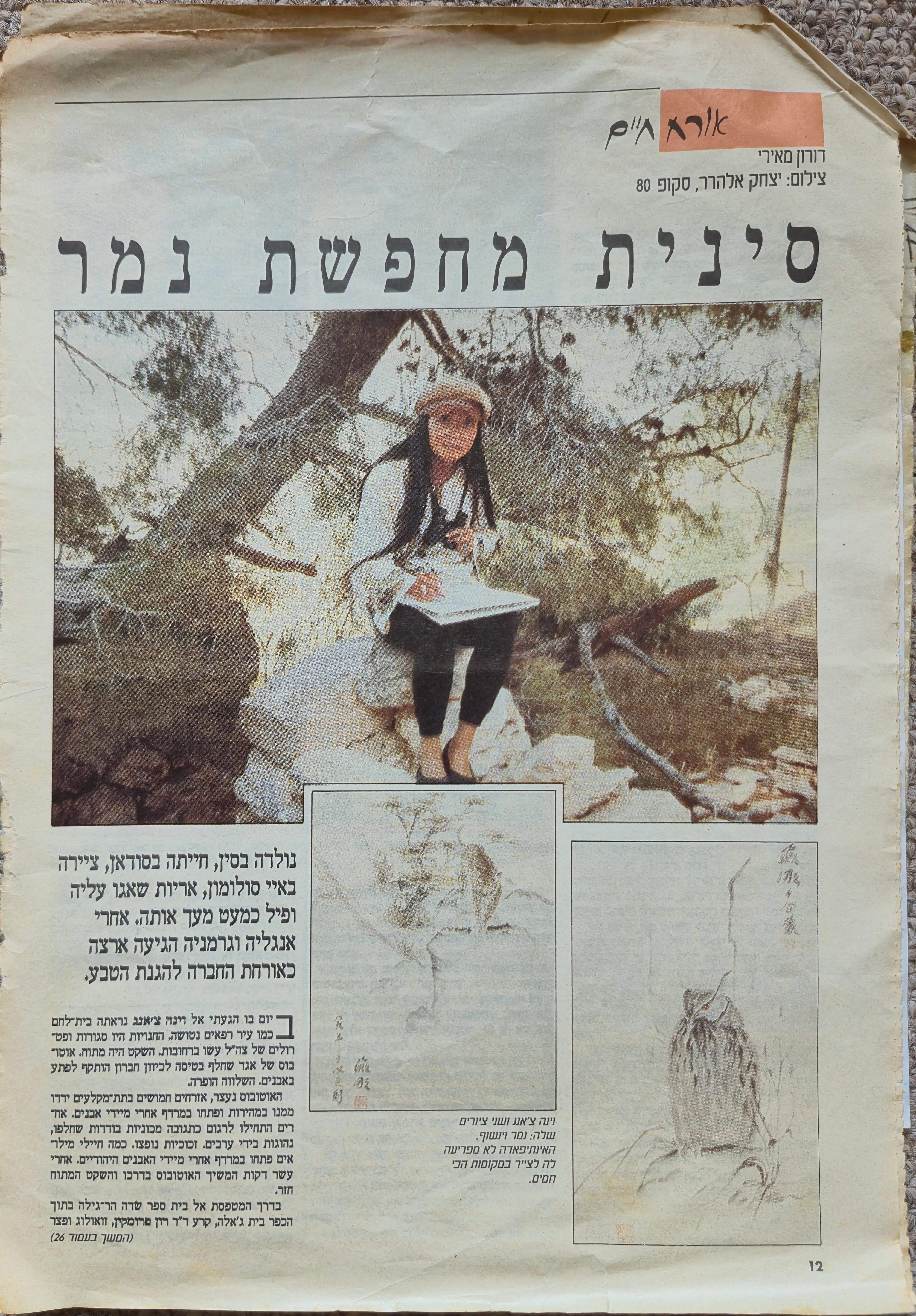
Captions for the main picture and paintings
Waina Cheng and two of her paintings: a leopard and an owl. The intifada did not stop her from painting in the hottest places.
Chinese lady looking for a leopard
Born in China, lived in Sudan, painted in the Solomon Islands, lions roared at her, and an elephant almost crushed her. After England and Germany, she came to Israel as a guest of the Society for the Protection of Nature
The day I reached Waina Cheng, Bethlehem looked like an abandoned ghost town. The shops were closed and IDF soldiers were patrolling the streets. The silence was tense. An Egged bus passing by on a route towards Hebron was suddenly attacked with stones. The peace was broken.
The bus stopped, civilians armed with submachine guns quickly got off and began chasing the stone throwers. Others began to stone in response a few passing cars, driven by Arabs. Windows were shattered. Several reserve soldiers began chasing the Jewish stone throwers. After ten minutes, the bus continued on its way and tense silence returned.
On the road climbing to the Har-Gila Field School in the village of Beit Jala, Dr. Rod Markhocoin, a zoologist and veteran, tore up the road, cutting through the turns. The main thing was not to hit any rocks.
Continuation of the article
At the Har-Gila field school, Chinese painter Waina Cheng sat, watching birds and painting. One afternoon she travelled to Jerusalem, in the evening she would return to Har-Gila, and so on almost every day. The intifada will not prevent a woman from China from coming to Israel and reaching the "warmest" places, and in two weeks she will be on the mountain.
It all started because of Dr. Ron Frumkin, from the Centre for Birds of Prey in Har Gila. When he was completing a doctorate in zoology at Oxford College in England, he came across a book in the library with drawings of birds. "I felt that whoever painted these birds did not copy the drawing from photographs, or paint a stuffed animal, but sat for hours and watched the birds, studied them thoroughly, and only then expressed it in the drawing," says Ron.
The two met and became friends. Ron said to Waina, "Why don't you come and paint in Israel?" Waina replied that she had never been to Israel and would be happy to come. After a short time, she did arrive in Israel as a guest of the Bird Information Centre of the Society for the Protection of Nature.
Waina Cheng was born in China 42 years ago. At a young age, her parents moved to Singapore, where she grew up. When she was eight, Chen Wen Hsi, a family friend and Chinese art teacher, came to visit the family. As usual, Waina would doodle. Chen Wen Hsi was fascinated by the drawings and took her to the academy with him. For 12 years, she studied art under him under an iron rule. At the age of 20, Waina went to England, where she began studying graphic design at Oxford, and married an English ornithologist who devoted his entire life to this subject.
The couple travelled in Africa for nine and a half years, Waina painting animals and birds, her partner studying their way of life. In Africa, she had an "artistic turning point." She decided that she would paint the animals "live," no longer copying from photographs and stuffed animals.
Encounter with a snake
In the Chinese people, she is considered a rebel; the rigid tradition of Chinese painting focuses only on paintings of romances, flowers, reeds, and landscapes, which represent the philosophy of Chinese art. Waina is aware of being a rebel. “The problem with the Chinese people,” she says without fear, “is that you are not allowed to be better than your teacher. You have to respect him. This respect plays no small part in shaping progress in China.”
The long years in Africa naturally brought with them a sea of adventures, near death. An encounter with a venomous mamba that finally decided to get away. A huge elephant that dragged the tent she was sleeping in and almost crushed her. She painted adult lions from ten meters away while completely exposed in the open.
After the trip to Africa, Waina decided to go to the Solomon Islands. This happened after her husband died in Sudan. She lived in the Solomon Islands for two years, then Waina spent another two years in England, two years in San Diego, California, and another two years in Germany. She always painted, and wherever she stayed, she sold her paintings, held exhibitions, and was successful. With the money she earned, she financed her travels around the world.
When she arrived in Israel, she decided she wanted to draw a leopard. She went to Ein Gedi, waited for days and days, and the leopard did not come. She went to the Tel Aviv Zoo and started drawing the leopard there.
At first he didn't like it, "Prey animals don't feel comfortable when a living figure they don't know is watching them. It's familiar to them, a predator lurking around," she explains. But the leopard got used to it. She said that over the days, he began to approach her with joyful leaps and one day even licked her hand. When she finished drawing him, she 'dressed him' in the landscape of Ein Gedi.
Waina sits for long hours in nature, observing the animals through a telescope and mirrors, and sketches them from different angles and in different poses. Then, when she gets to the studio, she uses the many sketches to create the final painting in watercolour, oil, and acrylic colours. When asked how long it takes her to paint a painting like this, she replied, "Years... Years of experience and hard work."
During her visit to Israel, she visited the Negev, the Arava, the Galilee and the Golan Heights, where she observed and painted animals. Waina Cheng paints animals because it is important to her that people see the beauty of animals, as she sees them. She loves animals and wants others to love them. She is fighting the extinction of rare animal species. When she finishes her visit to Israel, she will fly to England and from there to China. This is her first visit to her homeland after 41 years of exile and creativity. ■